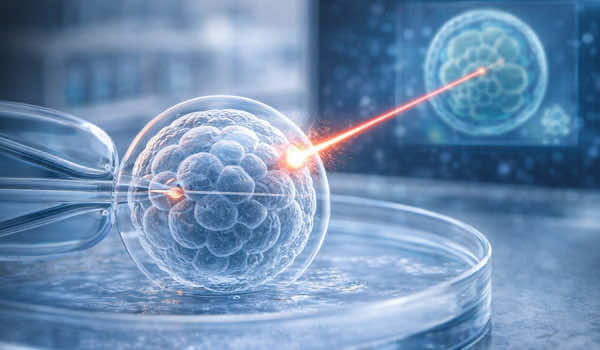
During the early days of embryo development, every embryo is surrounded by a thin outer shell called the zona pellucida. For implantation to occur, the embryo must break through this shell and attach to the uterine lining. Embryos created through IVF, ICSI or frozen transfers frequently have a thicker or tighter outer shell, which can make natural hatching more difficult. Laser-Assisted Hatching (LAH) is a precise technique that helps gently open this shell to support better implantation.
When Laser-Assisted Hatching in IVF May Help
LAH is not required for every patient, but it can be beneficial when the embryo needs additional support to implant successfully. Gynaecologists and fertility specialists recommend Laser-Assisted Hatching to patients who have:
- Previous IVF or ICSI failures.
- Embryos with a thicker zona pellucida.
- Poor embryo quality in earlier cycles.
- Women above 35 years of age.
- Frozen–thawed embryos that may lose some flexibility in the outer shell.
How the LAH Procedure Works
The Laser-Assisted Hatching in IVF is performed in the embryology lab before the embryo transfer. Here’s how it works:
- Embryo Selection
Embryos that have reached the appropriate stage of development are identified.
- Use of a Specialised Laser
A highly controlled laser beam is applied to create a tiny opening in the zona pellucida.
This is done without touching or damaging the embryo.
- Natural Hatching Support
The small opening allows the embryo to complete the hatching process more easily once inside the uterus.
- Embryo Transfer
After hatching assistance, the embryo is transferred into the uterus just like a regular IVF cycle.